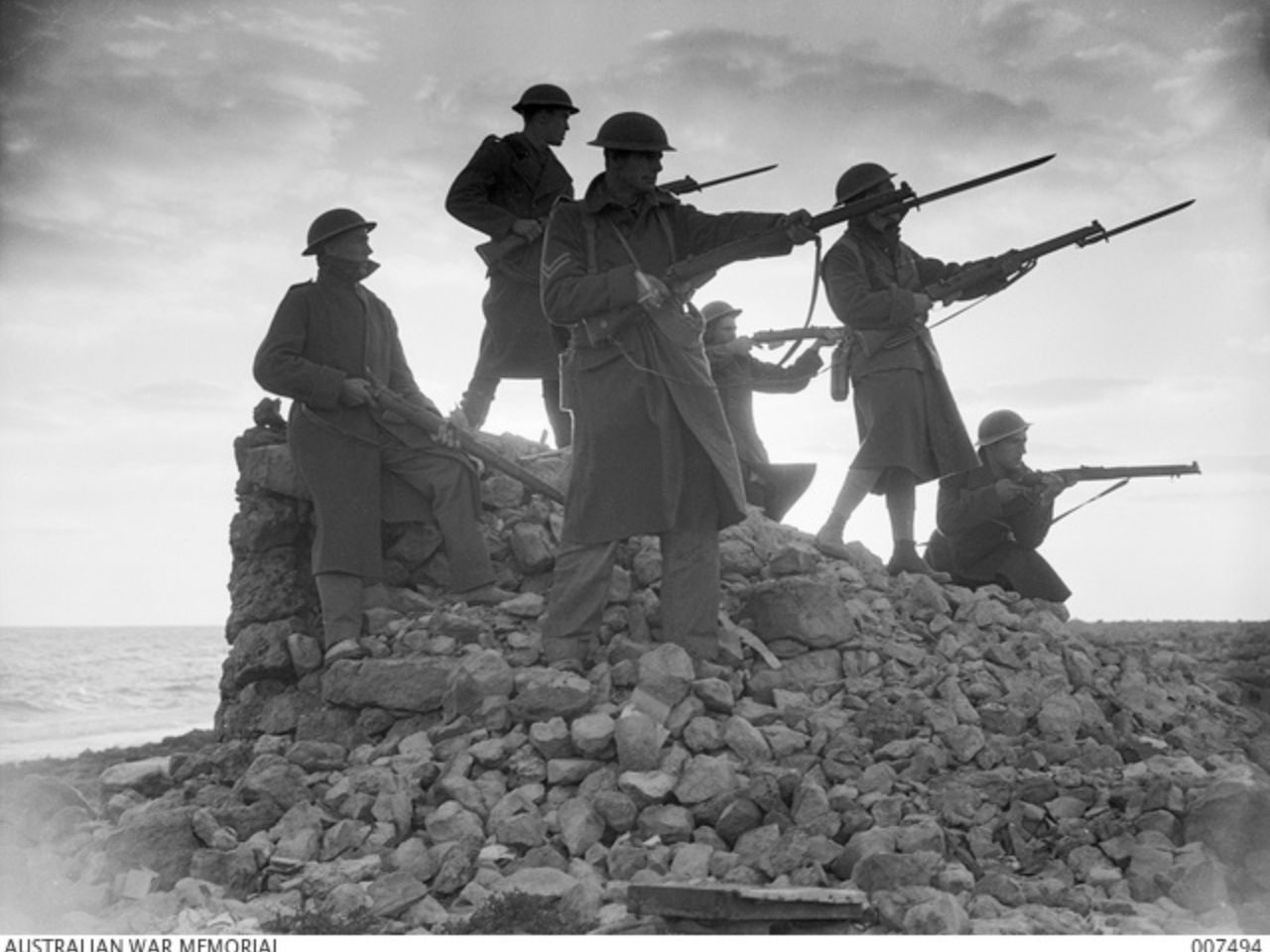
The Siege of Tobruk & Australian Fighting Patrols
DATE: 09/05/2026
TIME (GMT): 18:00
ERA: WW2
MAP(S): Tobruk
TYPE: COOP
GAME: Arma 3
EVENT: Un-official
AUTHOR(S): Bugs Bunny
SLOTS: 15 / 24
MEDICAL LEVEL: Basic
MEDICS SETTINGS: Normal
PREVENT INSTANT DEATH: Yes
LIVES: 3
DAMAGE RESISTANCE: 3
RESPAWN WAY: Respawn on Team
ENEMY DIFFICULTY: Medium
RATING:
During the early months of 1941, the war in North Africa became one of the most dynamic and mobile campaigns of the Second World War. After the collapse of Italian defenses in Libya during the British offensive known as Operation Compass, Allied forces pushed westward across Cyrenaica and inflicted a series of heavy defeats on the Italian army. The Italian position in North Africa was rapidly deteriorating, and German leadership feared that the loss of Libya could threaten Axis influence throughout the Mediterranean.
In response, Germany dispatched a military expeditionary force to North Africa under the command of Erwin Rommel. This force, known as the Afrika Korps, arrived in early 1941 and quickly began launching aggressive counterattacks against British and Commonwealth forces. Rommel’s strategy relied on speed, surprise, and maneuver warfare across the vast desert terrain.
Within weeks of arriving, German and Italian forces launched a rapid advance across eastern Libya. The Allied forces, stretched thin and unprepared for the sudden counteroffensive, were forced to retreat eastward. Despite these setbacks, the Allies chose to hold one crucial position: the fortified port city of Tobruk.
Tobruk was strategically important for several reasons. The city possessed a deep-water port capable of supporting large naval supply operations, which made it a vital logistical hub in the desert campaign. Additionally, Tobruk’s defenses—originally constructed by the Italians—formed a strong perimeter consisting of trenches, anti-tank ditches, barbed wire, and fortified strongpoints. Holding Tobruk allowed the Allies to disrupt Axis supply lines and prevent German forces from advancing deeper into Egypt.
The responsibility for defending Tobruk fell largely to the 9th Australian Division, a formation composed primarily of Australian infantry battalions that had been sent to the Middle East earlier in the war. Among these units was the 2/13th Battalion, part of the 20th Australian Infantry Brigade. These troops, alongside British artillery units and other Commonwealth elements, formed the backbone of the Tobruk garrison.
In April 1941, Axis forces surrounded the city and began what would become the long and difficult Siege of Tobruk. For more than eight months, the garrison endured constant artillery bombardment, aerial attacks, and repeated ground assaults from German and Italian forces.
However, the defenders of Tobruk did not simply remain behind their defenses. Australian commanders quickly adopted an aggressive doctrine designed to keep the enemy off balance. Rather than allowing the siege to become a static defensive struggle, the Australians conducted frequent night operations known as “fighting patrols.” These patrols involved small groups of infantry moving beyond the defensive perimeter under cover of darkness to attack enemy outposts, sabotage equipment, gather intelligence, and capture prisoners for interrogation.
The terrain surrounding Tobruk played a significant role in shaping these operations. The area was characterized by rocky desert plateaus, shallow dry riverbeds known as wadis, and sparse vegetation. The defensive perimeter stretched for many kilometers and was protected by extensive belts of barbed wire and minefields. Beyond these obstacles lay open desert where Axis forces had established forward observation posts, machine gun positions, and artillery spotting teams.
These forward positions were critical for the Axis forces because they allowed German observers to direct artillery fire onto the Tobruk defenses and monitor any Allied movement within the fortress. As a result, the destruction of these positions became a priority for the Australian patrols.
Typical patrol operations took place in the early hours of the morning, often beginning shortly after midnight. Small units of twenty to thirty soldiers would leave the safety of the Tobruk perimeter and carefully navigate through gaps in the defensive minefields. Once outside the wire, they would advance across several hundred meters of exposed desert terrain toward the enemy lines.
Stealth and surprise were essential. Patrols frequently crawled for long distances to avoid detection by German listening posts. When they reached their objective—usually a machine gun nest, trench position, or observation bunker—the attack was launched suddenly with grenades and concentrated small-arms fire. Bren light machine guns and Lee–Enfield rifles provided covering fire while assault teams destroyed equipment or searched the position for intelligence materials.
The entire engagement often lasted only a few minutes before the patrol withdrew. German reinforcements or flares illuminating the battlefield could quickly turn the situation dangerous for the attackers. Because of this, speed and discipline were critical to the success of these raids.
These operations served several important purposes. First, they allowed the Australians to gather valuable intelligence about Axis troop deployments and defensive layouts. Captured prisoners could be interrogated to reveal unit locations, supply conditions, or planned attacks. Second, the raids disrupted enemy observation posts and reduced the accuracy of German artillery fire against the Tobruk garrison. Finally, these patrols had a significant psychological effect. The constant threat of sudden night attacks forced Axis troops to remain alert and defensive, preventing them from settling into comfortable siege positions.
The soldiers defending Tobruk soon gained a reputation for their stubborn resistance and aggressive tactics. The German propaganda minister referred to them mockingly as the “Rats of Tobruk,” suggesting they hid in underground shelters to survive the bombardments. Rather than being insulted, the Australian troops adopted the name with pride, turning it into a symbol of resilience and determination.
Throughout the siege, these patrol clashes and small raids formed an essential part of the struggle for control around Tobruk. Although they rarely involved large numbers of troops, they demonstrated the importance of initiative and small-unit leadership in desert warfare.
The mission you are about to undertake represents one of these typical fighting patrols conducted by Australian infantry during the siege. Your objective is to move beyond the defensive perimeter under cover of darkness and eliminate a German forward observation post that is directing artillery fire onto Allied positions. Success will disrupt enemy operations and provide valuable intelligence to the Tobruk garrison.
In the harsh desert environment surrounding Tobruk, every patrol carried significant risk. Yet these daring raids helped ensure that the defenders remained an active and dangerous force despite being surrounded by enemy armies.
You can join our event at least two hours before the starting time. Please consider filling Squads before taking a slot in an empty group. Please, don't forget to rate the event after it finishes!
2/13th Battalion-20th Australian Infantry Brigade
Stretcher Bearer (Medic)
PatchMachine Gunner (Bren)
SzopixMachine Gunner (Lewis)
muztikasAmmo Bearer
W.JarvisSharpshooter
hampterAnti Tank Gunner
angleRifleman (Bazooka)
el hampteroSection Leader
BioStretcher Bearer (Medic)
UsagiMachine Gunner (Bren)
Dr. LexusAmmo Bearer
buliaSharpshooter
Louis_BolgarovAnti Tank Gunner
SpeedKingRifleman (Bazooka)
Magnum
To be able to JOIN event or WRITE a review, you should register/login by using your
STEAM account